

DHA to Vitamin C: What the Research Actually Says About 8 Everyday Nutrients
If you've ever stood in the vitamin aisle wondering whether any of it actually does what the bottle claims, you're asking the right question.
We built Premiux around answering it honestly — every claim on every label should trace back to a real study, not a marketing department. Here's what the published research actually says about eight nutrients across our gummy line: DHA, biotin, melatonin, prebiotic fiber, collagen, vitamin D3, vitamin K2, and vitamin C.
DHA: Why Algae, Not Just Fish
Fish don't make DHA. They accumulate it by eating algae — which means algae, not fish, is the original source. A 2014 review of vegetarian omega-3 sources confirms algal DHA is capable of raising DHA levels in human blood on its own, making fish unnecessary as the delivery mechanism.
That matters because DHA isn't a generic "healthy fat." It's a structural fatty acid concentrated in neuronal cell membranes in the brain, and it's also a structural component of retinal cell membranes, according to the NIH Office of Dietary Supplements. A 2008 study found algal-DHA capsules and cooked salmon produced comparable DHA delivery to blood in human subjects — and a 2025 randomized, double-blind trial confirmed it again, finding algal oil statistically non-inferior to fish oil at raising plasma DHA and EPA.
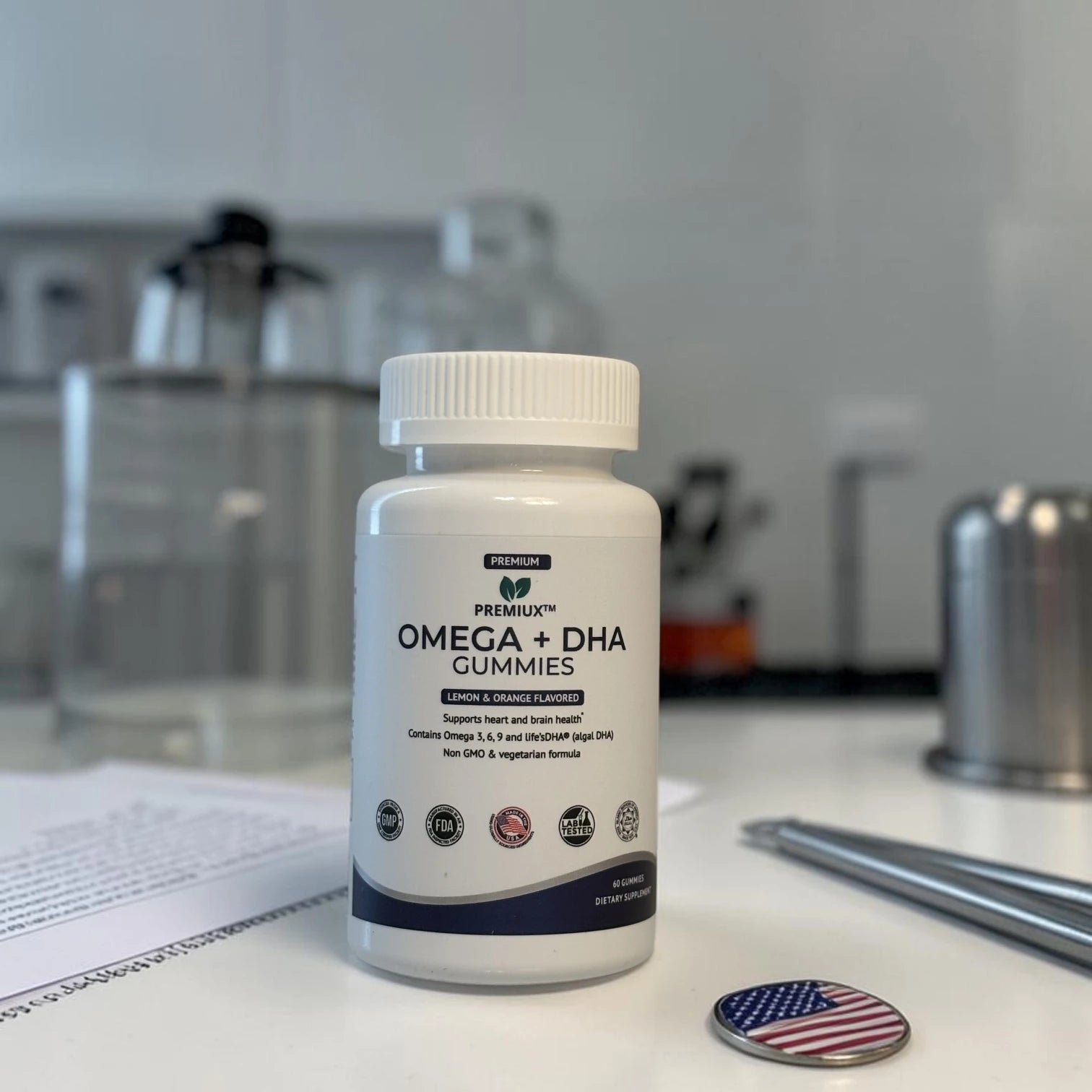
Premiux's Omega + DHA Gummies use algal DHA for exactly this reason — a direct source, without fish.
Biotin: What the Hair, Skin & Nail Evidence Actually Shows
Biotin (vitamin B7) is a genuine cofactor for enzymes involved in fatty-acid, glucose, and amino-acid metabolism — it's essential, full stop. Hair loss can be a real sign of biotin deficiency, and deficiency can also cause skin rash and brittle nails.
But here's the nuance most beauty-brand marketing skips: a 2017 review in Skin Appendage Disorders found published hair-growth improvements from biotin supplementation are mostly reported in people who had an underlying deficiency or disorder to begin with. For healthy adults without a deficiency, clinical evidence that extra biotin grows "more" hair remains limited. Small, non-placebo-controlled studies have found harder or thicker nails after biotin supplementation in some people with brittle nails — promising, but not proof of a universal effect.
The honest takeaway: biotin deficiency clearly matters; biotin excess hasn't been proven to create dramatically better hair. Premiux's Biotin Gummies (5,000mcg) are dosed around the mechanism that's actually been studied — not around the idea that more is automatically better.
Melatonin: A Signal, Not a Sedative
Melatonin isn't foreign to your body. Your brain produces it naturally at night, and its biological job is tied to regulating your sleep-wake rhythm — levels normally rise as biological night approaches. Supplemental melatonin works with a signaling system your body already uses, which is why timing it correctly matters as much as the dose.
A meta-analysis of primary sleep-disorder trials published in PLOS ONE found melatonin can shorten the time it takes to fall asleep — but the average effect is modest, alongside small improvements in total sleep time and sleep quality. A more recent 2024 dose-response analysis in the Journal of Pineal Research reinforces that more milligrams don't automatically mean better sleep: benefits changed with both dose and timing, not with dose alone.
Premiux's Melatonin Gummies use 5mg for occasional sleeplessness — sized around what the research actually supports, not the highest number we could put on a label.
Chicory Root Fiber: Feeding Your Gut Microbiome
Not all fiber just adds bulk. Chicory-root inulin is a fermentable prebiotic fiber — your gut bacteria can use it as food, even though you can't fully digest it yourself. A 2023 systematic review with meta-analyses found chicory-derived inulin-type fructans increased Bifidobacteria abundance, the mechanism that separates a true prebiotic from generic "fiber."
On regularity specifically: a randomized, double-blind, placebo-controlled trial using 12g/day of chicory inulin increased stool frequency compared with placebo in adults with constipation, and a separate trial using 10g/day of native chicory inulin produced similar results in people with low stool frequency.
Premiux's Fiber Gummies provide 5g of chicory-root prebiotic fiber per serving — a daily foundation to help bridge the gap between what you get from food and your fiber goal, not a substitute for the higher doses used in those clinical trials.
Collagen, Vitamin C & Zinc: The Beauty-From-Within Trio
Collagen is one of the key structural proteins in your skin, and clinical trials of oral collagen peptides — typically several grams per day — have reported real improvements in skin hydration and elasticity. One randomized trial using 10g/day of collagen peptides found significantly increased skin hydration after eight weeks.
But collagen doesn't work alone. Your body needs vitamin C to synthesize collagen in the first place — it's an essential cofactor in that process — and zinc contributes to the cell proliferation, tissue repair, and immune function that skin depends on. Research on hair, skin, and nails consistently points the same direction: biotin, vitamin C, zinc, and protein each play distinct, complementary roles.
That's the logic behind Premiux's Beauty Multivitamin Gummies: 200mg collagen paired with biotin, vitamin C, and zinc in one formula, to help bridge everyday beauty-nutrition gaps rather than relying on a single ingredient to do all the work.
Vitamin D3 & Vitamin K2: Two Nutrients, Different Jobs
Vitamin D helps your intestine absorb calcium, making it central to normal bone mineralization. Vitamin K plays a separate, complementary role: it activates proteins involved in bone metabolism, including osteocalcin, which requires vitamin-K-dependent carboxylation to function. MK-7 — the form of K2 used in Premiux D3 + K2 Gummies — has been studied directly: a randomized trial found low-dose MK-7 supplementation improved osteocalcin carboxylation over three years. That supports a real biological role — not the oversimplified "K2 sends calcium to your bones" claim you'll see elsewhere.
Vitamin D's reach goes beyond bone, too. Your skin makes it from UVB light, but diet and supplements matter when sun exposure isn't enough — which is why Premiux also offers a standalone Vitamin D Gummies 2000IU option. A randomized trial confirmed that supplementation effectively raises circulating 25-hydroxyvitamin D, the actual clinical marker used to assess vitamin D status — not a marketing claim. Vitamin D receptors also show up in immune tissue, and systematic reviews support a role for vitamin D in normal immune function.
The takeaway: bone health isn't a one-vitamin job. D supports absorption; K supports the proteins that use it — different nutrients, different jobs, same system.
Vitamin C: Beyond Cold Season
Vitamin C's job starts before immunity. Your body cannot synthesize collagen normally without it — it's an essential cofactor in collagen formation. It's also a water-soluble antioxidant that donates electrons to neutralize free radicals, part of why it matters to normal cell function generally. Vitamin C concentrates in several types of immune cells and supports functions across both the innate and adaptive immune system.
On the question everyone actually wants answered — does it stop colds — the honest answer is no, not reliably. A Cochrane analysis found regular vitamin C use was associated with about an 8% reduction in cold duration in adults: a modest effect, not a cure. Premiux's Vitamin C Gummies (250mg) support that role — immune function and collagen synthesis — without overselling what a modest, real effect actually is.
The Bottom Line
Most of what's in a Premiux gummy has real, citable research behind it — but the honest version of that science comes with caveats: doses matter, timing matters, and "supports normal function" is never the same claim as "cures" or "prevents." That distinction is exactly why we publish the sources instead of just the claims, on every product page and in every piece of content we put out.
These statements have not been evaluated by the Food and Drug Administration. This product is not intended to diagnose, treat, cure, or prevent any disease.
References: Lane K, et al. Bioavailability and potential uses of vegetarian sources of omega-3 fatty acids: a review of the literature. Critical Reviews in Food Science and Nutrition. 2014;54(5):572-579. NIH Office of Dietary Supplements, Omega-3 Fatty Acids Fact Sheet. Arterburn LM, et al. Algal-oil capsules and cooked salmon: nutritionally equivalent sources of docosahexaenoic acid. Journal of the American Dietetic Association. 2008;108(7):1204-1209. Bailey E, et al. Comparative Bioavailability of DHA and EPA from Microalgal and Fish Oil in Adults. International Journal of Molecular Sciences. 2025;26(19):9343. NIH Office of Dietary Supplements, Biotin Fact Sheet. Patel DP, et al. A Review of the Use of Biotin for Hair Loss. Skin Appendage Disorders. 2017;3(3):166-169. Savage RA, et al. Melatonin. StatPearls Publishing, updated 2024. Ferracioli-Oda E, et al. Meta-Analysis: Melatonin for the Treatment of Primary Sleep Disorders. PLOS ONE. 2013;8(5):e63773. Cruz-Sanabria F, et al. Optimizing the Time and Dose of Melatonin as a Sleep-Promoting Drug. Journal of Pineal Research. 2024;76(5):e12985. Nagy DU, et al. Effect of chicory-derived inulin-type fructans on abundance of Bifidobacterium and on bowel function: a systematic review with meta-analyses. Critical Reviews in Food Science and Nutrition. 2023. Micka A, et al. Effect of consumption of chicory inulin on bowel function in healthy subjects with constipation. International Journal of Food Sciences and Nutrition. 2017;68(1):82-89. Watson D, et al. Changes in stool frequency following chicory inulin consumption. Food Hydrocolloids. 2019. Pu SY, et al. Effects of Oral Collagen for Skin Anti-Aging: A Systematic Review and Meta-Analysis. Nutrients. 2023;15(9):2080. Asserin J, et al. The effect of oral collagen peptide supplementation on skin moisture and the dermal collagen network. Journal of Cosmetic Dermatology. 2015;14(4):291-301. Pullar JM, et al. The Roles of Vitamin C in Skin Health. Nutrients. 2017;9(8):866. Lin PH, et al. Zinc in Wound Healing Modulation. Nutrients. 2017;10(1):16. Almohanna HM, et al. The Role of Vitamins and Minerals in Hair Loss: A Review. Dermatology and Therapy. 2019;9(1):51-70. NIH Office of Dietary Supplements, Vitamin D Fact Sheet. NIH Office of Dietary Supplements, Vitamin K Fact Sheet. Knapen MHJ, et al. Three-year low-dose menaquinone-7 supplementation helps decrease bone loss in healthy postmenopausal women. Osteoporosis International. 2013;24(9):2499-2507. Aspray TJ, et al. Randomized controlled trial of vitamin D supplementation in older people to optimize bone health. American Journal of Clinical Nutrition. 2019;109(1):207-217. Jolliffe DA, et al. Vitamin D supplementation to prevent acute respiratory infections. Lancet Diabetes & Endocrinology. 2021;9(5):276-292. Carr AC, Maggini S. Vitamin C and Immune Function. Nutrients. 2017;9(11):1211. Hemilä H, Chalker E. Vitamin C for preventing and treating the common cold. Cochrane Database of Systematic Reviews. 2013;(1):CD000980.


Leave a comment
This site is protected by hCaptcha and the hCaptcha Privacy Policy and Terms of Service apply.